Six restaurants on the Monterey Peninsula run on sites we built — with the food photography shot in-house, menus people can actually read on a phone, and the reservation button where a hungry person will find it.
Someone is standing on a corner with their phone out, deciding between you and two other places. They want to know four things: what the food looks like, whether you are open, whether they can get a table, and where to park. If your site makes them hunt for any of it, they tap back and go somewhere else.
Which is why the photography is not decoration — it is the product. A restaurant sells an experience that nobody can taste through a screen, so the pictures are doing the selling. Most web designers ask you to send photos and build around whatever arrives. We shoot it: plated dishes, the room mid-service, the bar, the people. Your site shows your restaurant, not a stock photo of someone else's burger.
We have designed menus, signage and print for Peninsula restaurants since 1994, which means we arrive already knowing how a dinner service works, why you cannot shoot the dining room at 7pm on a Saturday, and what a menu looks like when it has to be read in dim light.
Also built for Nora's and The Grill on Ocean Avenue. Menus, signage, photography and print for Alfredo's Pastaria, Mezzaluna Pasteria, Gusto Pasta & Pizza, Flaherty's Seafood Grill, Cafe Carmel, Mulligan Public House, Links Club, Cypress Inn and Etats-Unis.
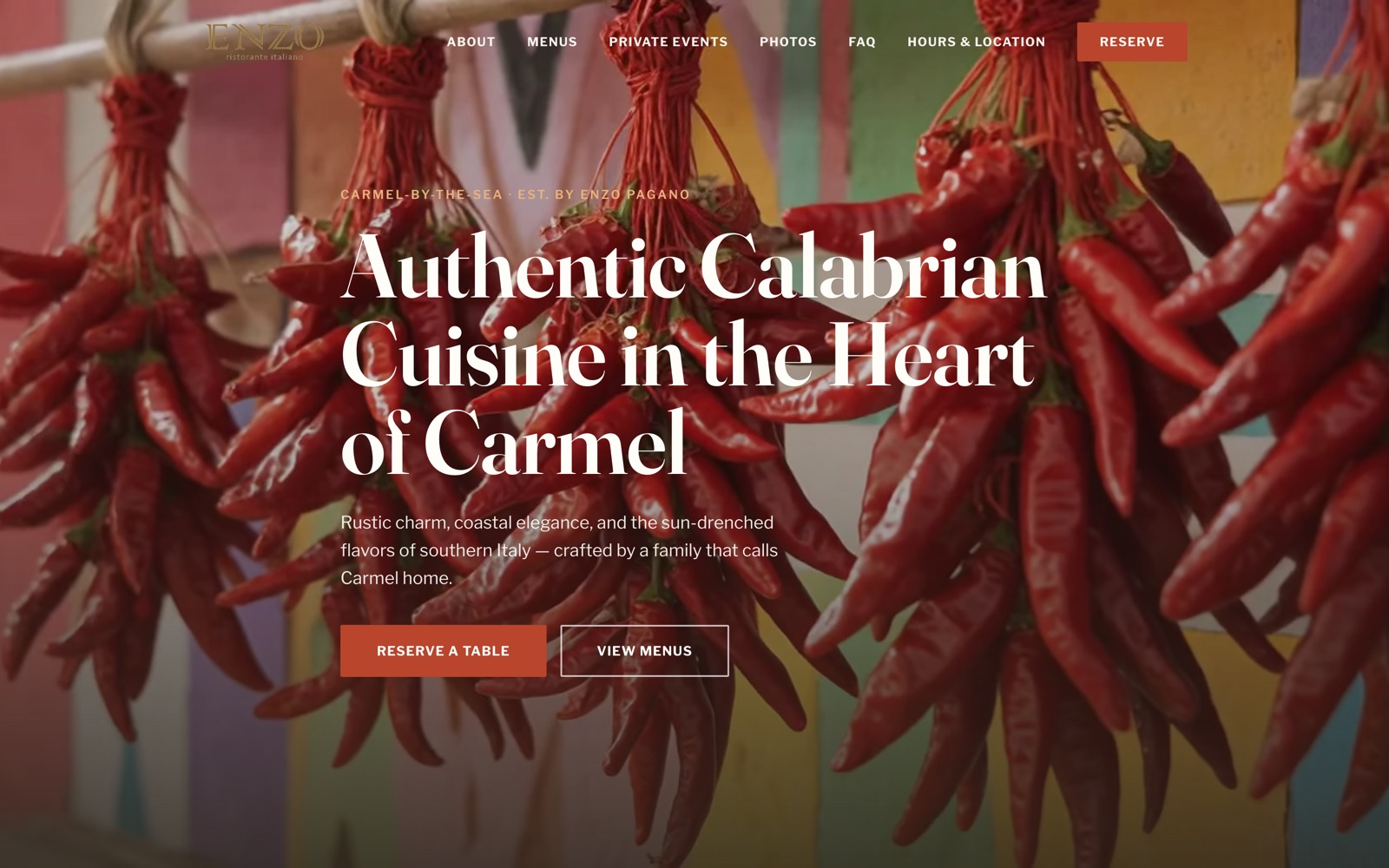
Enzo Ristorante Italiano is a family kitchen on San Carlos, cooking the food of Calabria — the far south of Italy, which most American diners cannot place on a map. That is a hard thing to sell in a town with a hundred restaurants and a visitor who has twenty minutes to choose one.
So the site leads with the thing no competitor can copy: the food, and the family behind it. The home page opens on strings of Calabrian chiles, then names Enzo and Italo on the page rather than burying them in an About tab. A visitor understands within one screen that this is a specific family cooking a specific region's food, not generic Italian.
Menus are text on the page, not a PDF, so a guest can read them on a phone and Google can index every dish. Reservations run through OpenTable straight into the book they already keep. Private events, which is where a restaurant's margin often lives, gets a full page instead of a line in the footer.
Underneath, the site declares itself to Google as a Restaurant, with the address and opening hours for every day of the week in the structured data. It is the part a guest never sees, and it is most of what decides whether they find the place at all.
Who eats here, who you wish ate here, and what you want the site to make happen — covers, private events, catering, a quieter Tuesday. A restaurant site built without that becomes a pretty brochure.
Usually a late morning or an afternoon between services. Your chef plates the dishes you actually want to sell, we shoot the room while the light is good, and nobody has to cook an extra service for the camera.
Menus typed as real text, priced and organised the way you serve them. Everything a guest asks before booking gets a place, and everything that earns money — private dining, catering, gift cards — gets a page rather than a line.
Pages built around your photography and made to load fast on a phone on a weak signal. Then the search work: restaurant structured data, hours, sitemap, Search Console, and your Google Business Profile brought into line.
We handle the domain and email so nothing goes dark mid-service. Afterwards menus change, chefs change and seasons turn — you call 831-236-1998 and reach the person who built it.
A cafe, a bakery, a counter-service spot: one menu, hours, location, contact. Everything a guest needs and nothing they do not.
Where nearly every full-service restaurant lands. Food and drink menus, events, private dining, your story, reservations connected, and the photo shoot that carries all of it.
Multiple locations, hotel restaurants, online ordering, ticketed events, or a booking system that has to talk to something else.
Every project gets a firm written number before any work begins — usually within a day of talking. The photo shoot is included in all three tiers, which for a restaurant is the line item that otherwise arrives as a surprise. What moves a project up a tier is rarely page count: online ordering, a second location, ticketed events, or menus that need writing from scratch are the usual reasons.
Restaurant websites fail in predictable ways, and almost none of them are about how the site looks.
The menu is a PDF. This is the most common and most expensive mistake. Google cannot read a PDF menu, so none of your dishes appear in search. On a phone it opens as a document the guest has to pinch and drag. Every dish name, every price, every description should be text on the page — it is better for the guest and it is free search traffic you are currently throwing away.
The hours are wrong, or hidden. Nothing loses a table faster than a guest who cannot tell whether you are open right now. Hours belong on the first screen and in the structured data, and they have to match your Google listing exactly — because for most searches, the Google panel is what people read, not your site.
The photos are not of your restaurant. Stock photography on a restaurant site is worse than no photography. Diners are better at spotting it than owners think, and the moment they spot it they stop trusting everything else on the page.
Nothing says where to park. In Carmel and downtown Monterey this is a genuine reason people choose one restaurant over another. If parking is free, or easy, or there is a lot behind the building, that sentence is worth more than a paragraph about your culinary philosophy.
And the booking button is buried. Reserve, order, call — whichever matters most for your room should be visible without scrolling, on every page, on a phone held one-handed on a street corner.
Talk It ThroughMost restaurant sites land in our mid-size tier, $4,500 to $7,000, which covers eight to fifteen pages: home, menus, drinks, events, private dining, story, contact. A small place with a single menu and no events can work at $3,200. Multi-location groups, online ordering, or a booking system run $7,500 and up. A photo shoot of your food and room is included at every tier.
Yes, and it is the main reason restaurants hire us. Manny is a working commercial photographer, so the shoot is part of the build rather than something you arrange separately. We shoot plated dishes, the room during service, the bar, and the people, which means your site shows your actual restaurant instead of stock images of someone else's.
Yes. We connect whatever booking system you already use — OpenTable, Resy, Tock, SevenRooms — so the reserve button goes straight into your existing book and nothing changes for your host stand. Enzo Ristorante runs OpenTable this way. If you take reservations by phone, we make the number tappable and put it where a hungry person will actually find it.
Menus change and the site has to keep up. We build menus as real text on the page rather than as a PDF, because Google cannot read a PDF menu and neither can a phone easily. For most clients we handle updates; where an owner wants to make changes themselves, we set the menus up so they can. Either way you are not waiting weeks for a price change.
No. A PDF menu is the single most common mistake on restaurant websites. It will not show in search results, it is painful to read on a phone, and it hides your dish names and prices from Google at exactly the moment someone is deciding where to eat. Menus belong on the page as text.
We can, though it is worth a conversation first. Third-party delivery takes a serious cut, and for many Peninsula restaurants direct pickup ordering makes more sense than signing up for every app. We will tell you honestly whether your business needs it or whether the money is better spent elsewhere.
Every site we build ships with the groundwork search engines look for: fast pages, titles and descriptions written for what diners actually search, structured data describing the restaurant with hours, location and price range, a sitemap, and Search Console setup. For restaurants, your Google Business Profile matters as much as the website, since it is what appears in the map pack and in the panel beside your name. We set that up alongside the site and make the two agree.
Yes. The studio is in Carmel-by-the-Sea and most of our restaurant work is here — Carmel, Monterey, Pacific Grove, Carmel Valley — because the photo shoot is part of the build and that is easiest when we can drive to you. We take projects further afield when the shoot can be scheduled properly. Tell us where you are and we will be straight about whether it works.
Three to six weeks from the first conversation to launch, including the photo shoot. The shoot is usually the scheduling constraint rather than the build: we need the kitchen at a time that does not wreck your service, and good light in the room. If you are opening on a fixed date, tell us the date first and we will work backwards from it.
Looking for a website designer near you? We take web design and website redesign projects in each of these communities, and we come to you.